
Choosing a study Bible is easy to rush. The shelf at the bookstore is crowded, the covers look alike, and the advertising promises a lot. A study Bible stays with you for years, though, so it deserves a decision made in the right order. This article gives you that order: first the translation you will actually read, then the kind of notes you need, then the features worth having. If you want to know how to choose a study Bible without regretting the purchase, that sequence matters more than any single product.
What a study Bible is, and what it can’t do for you
A study Bible is a complete Bible with added help printed around the text. The help usually includes introductions to each book, notes at the bottom of the page, cross-references to related passages, maps, and charts. The goal is to give you background you would otherwise have to hunt for: who wrote a book, who it was written to, what the culture was like, and how one passage connects to another.
That help is valuable. In Acts 8, an Ethiopian official is reading Isaiah and Philip asks whether he understands it. He answers, “How can I, unless someone guides me?” (Acts 8:30-31). Study notes can play a small part of that guiding role, especially when you have no teacher beside you.

There is one thing a study Bible cannot do, and it is worth saying before you spend any money. It cannot read the Bible for you. Notes explain, but they cannot replace your own slow reading of the text, and they cannot change your life. Paul says that “all Scripture is breathed out by God and profitable for teaching, for reproof, for correction, and for training in righteousness” (2 Timothy 3:16). The word he uses is Scripture, meaning the biblical text itself. The notes around it are the work of people.
So ask a question before you shop: do I want a tool that sends me deeper into the text, or a book that does my thinking for me? Only the first kind is worth buying.
Start with the translation you will actually keep reading
Most buyers start by comparing notes and features. Start instead with the translation, because the translation is the part you will read every day. Nehemiah 8:8 describes the people hearing the Law read aloud, “giving the sense, so that the people understood the reading.” Understanding is the point, and a translation you find stiff or confusing will end up closed on the shelf.
A good test is simple. Open a Bible to a passage you already know a little, such as Psalm 23 or the opening of John, and read a full page aloud. Notice where you stumble. Notice whether the sentences feel natural or whether you reread them to get the meaning. A translation that is accurate but exhausting to read may not be the right first choice, and a translation that reads smoothly but loosens the wording too far may not serve study well either.
Consider also who you will read alongside. If your church preaches from one translation, owning the same one lets you follow along and underline what the pastor reads. If you meet with a small group, ask what they use. Matching a translation is not required, but it removes friction, and friction is a common reason new readers stop.
Word-for-word, thought-for-thought, paraphrase: what the difference means in practice
Translators face a real problem. Hebrew and Greek do not map neatly onto English, so every translation makes choices. Those choices fall along a range with three broad categories.
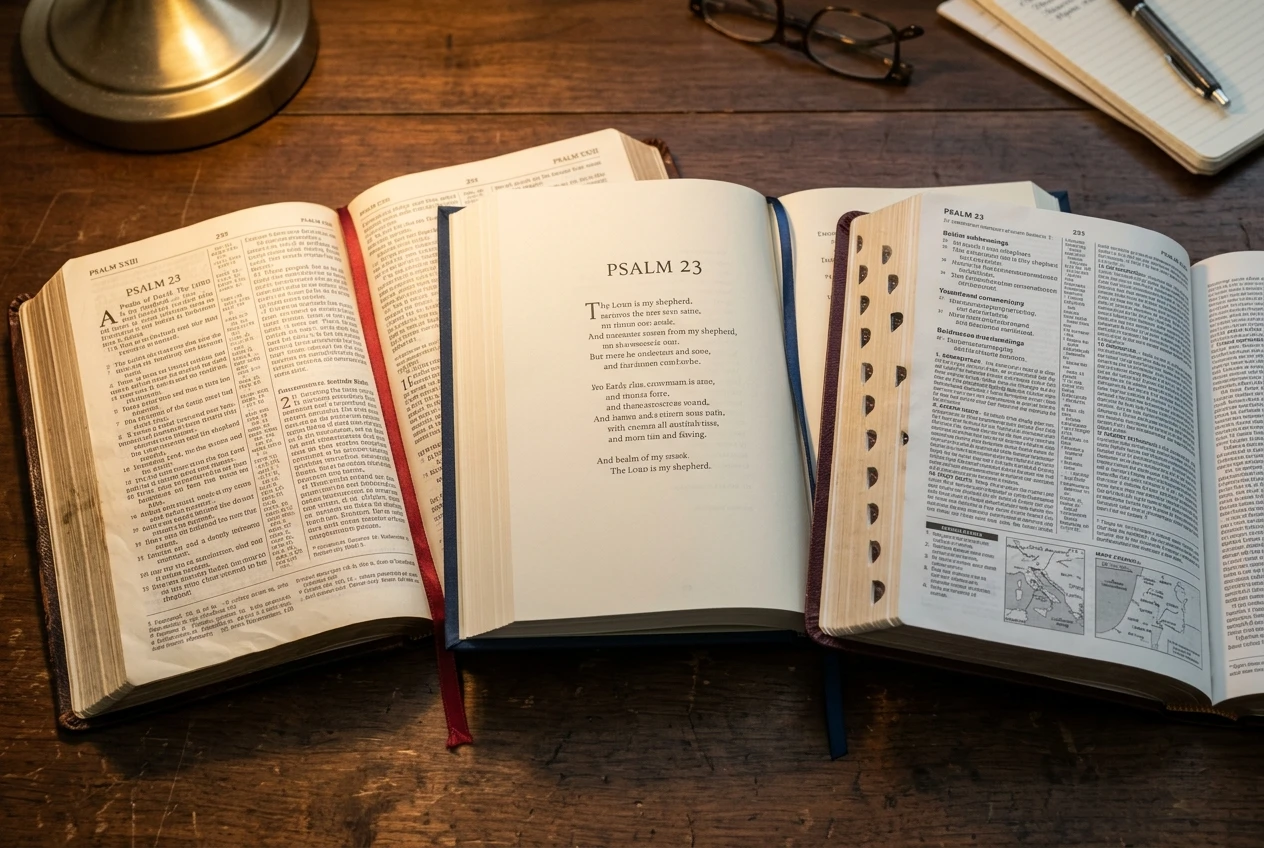
Word-for-word (formal equivalence). These translations stay close to the original wording and sentence structure. Well-known examples include the ESV, NASB, and KJV. They are useful for close study because you can see more of the original’s structure, but the sentences can be longer and the vocabulary more demanding.
Thought-for-thought (dynamic or functional equivalence). These translations aim to carry the meaning of each phrase into natural English even when the structure changes. The NIV and NLT are commonly placed here, with the NLT usually described as further toward readability. They read easily, which helps new believers keep going, though the translators have made more interpretive decisions for you.
Paraphrase. A paraphrase restates the text in the writer’s own words, often freely. The Message is a familiar example. It can be refreshing as a second voice beside a main translation. As the only text for serious study, it gives you the least ability to check what Scripture actually says.
In practice, a word-for-word translation lets you see more of the text yourself, while a thought-for-thought translation lowers the barrier to understanding. Neither category is a moral choice. Many careful readers keep a main translation for study and read a second one for comparison. If you are buying one study Bible, choose the translation you can read for twenty minutes without fatigue, and check that it is accurate enough that you can trust it as your main text.
Study notes are commentary, not Scripture: how to read them wisely
Here is the most important point in this article. The words in the notes were written by editors and scholars, not by the authors of Scripture. They are commentary. Good commentary is a gift, but it is still a human interpretation, shaped by the training, church background, and convictions of the person writing it.
Scripture warns against adding to God’s words. “Every word of God proves true… Do not add to his words, lest he rebuke you and you be found a liar” (Proverbs 30:5-6). A careful reader keeps a clear line between what the text says and what a note says about it.
Many study Bibles help you see that line. The Bible text runs in one block of type and the notes sit separately, usually in smaller print below. Treat the gap seriously. Here are habits that help:

- Read the passage first, alone. Write down what you think it says and what questions you have, then look at the notes.
- Check the note against the verse. Does the note’s claim actually appear in the words you just read, or is it an inference? Many notes mix both.
- Notice the language of certainty. Phrases like “this clearly means” deserve a second look on topics where Christians disagree.
- Follow the cross-references. When a note cites other verses, read them. The Bereans were praised because they “examined the Scriptures daily to see if these things were so” (Acts 17:11). That example applies to sermons, books, and study notes alike.
- Keep your own questions. An unanswered question is not a failure. Bring it to a pastor or a mature believer in your church.
Reading notes this way does not mean distrusting them. It means placing them where they belong, below the text, as help from fellow students and never as the final word.
Features worth having and features you can skip as a beginner
Study Bibles advertise long lists of extras. Not all of them help someone buying a first copy.
Features worth having
- Book introductions. A short overview of authorship, setting, purpose, and outline gives you context before you read. This is often the most useful part of a study Bible.
- Cross-references. These show you how the Bible interprets itself, which is a safer habit than leaning on notes alone.
- Textual footnotes from the translators. Some Bibles note, for example, that certain early manuscripts do not contain a passage such as John 7:53 to 8:11 or Mark 16:9-20. Knowing this is honest and helpful.
- Maps and a short timeline. Geography and chronology make narratives easier to follow.
- A concordance or topical index. Even a brief one lets you find where a word or theme appears.
- Readable print and sturdy paper. If the type is small or the pages show through, you will read less. Check this in person if you can.
- Room to write. Wide margins or space for notes help you answer the text in your own words.
Features you can skip at first
- Daily devotional inserts. They can crowd your attention away from the text.
- Long theological essays and articles. Useful later, but heavy for a first reader.
- Photo-heavy layouts. Attractive, but they raise the price without improving understanding.
- Extra tabs, ribbons, and covers. Choose these on comfort, not on how many there are.
- App bundles and promotional add-ons. If you want digital tools, you can add them separately. The post on using technology in Bible study covers that choice on its own.
A plain study Bible with good book introductions, cross-references, and readable type will serve a beginner better than a heavily loaded one.
Why the theological background of a study Bible matters, and how to find it out
Every set of notes comes from somewhere. The editors belong to churches and traditions, and their view of difficult passages follows from that. Christians across traditions hold the core of the faith together, yet they differ on matters such as baptism, how the spiritual gifts work today, the timing of end-time events, and how God’s sovereignty relates to human choice. A study Bible will usually take a position on these questions, sometimes openly and sometimes quietly.
This is not a reason to avoid study Bibles. It is a reason to know whose voice you are hearing. If you are unaware of the background, you may absorb one tradition’s answer as if it were simply “what the Bible says.” Where Christians differ, the notes are one reading among several.
You can find out the theological background with a little checking:
- Read the preface or introduction. Publishers often describe their approach and doctrinal commitments there.
- Look at the contributors. Many study Bibles list their editors and writers, along with their churches or schools. A quick search of those names shows where they stand.
- Check the publisher’s statement of faith. Some state it on their website.
- Test a disputed passage. Turn to a verse where Christians disagree, such as Acts 2:38 or Romans 9, and read how the notes handle it. A fair note often admits that other readings exist and names them.
- Ask your pastor or a mature believer at your church. They can tell you how a given Bible fits with what your church teaches.
If your church holds a clear position on the doctrines it considers essential, a study Bible from a compatible background will help rather than confuse you. Whatever you choose, remember that the text of Scripture is the authority and the notes answer to it.
A simple way to test two or three Bibles before you buy
Narrow the field before you test. Pick two or three study Bibles in a translation you can read comfortably. Then give each one the same short trial, in a bookstore or from a sample you can view online.

- Read one familiar passage aloud. Choose something like Romans 8 or John 3. Note how the translation flows and whether the print is easy on the eyes.
- Open the book introduction for that passage’s book. Ask whether it taught you something useful about the setting and purpose in plain language.
- Read the notes on an easy verse. Do they help you see the text, or do they mostly repeat it?
- Read the notes on a hard or disputed verse. Look for clarity, fairness, and a willingness to say “Christians interpret this differently.”
- Follow two cross-references. See whether they genuinely connect to the idea.
- Hold it. Consider the weight, the page thickness, and whether you can see yourself carrying it to church.
Score each Bible honestly on how much it moved you toward the text. The one that sends you back to the Bible most often is usually the better buy, even if another has more features. Compare prices only after this test, so price does not decide for you.
Your first month with a study Bible: how to use the notes without letting them replace the text
A new study Bible is easiest to misuse in the first few weeks, when you are eager and the notes are all new. A plain routine protects you from over-reliance.
Week one: read the text alone, then the notes. Pick one short book, such as Philippians or the Gospel of Mark. Read a chapter, write one sentence on what it says, and only then open the introduction and notes. Notice how much you saw yourself before the notes spoke.
Week two: ask three questions of each passage. What does it say? What did it mean to its first readers? What does it ask of me now? Use the notes mainly for the second question, since background is where they help most.
Week three: compare a note with another source. Take one note that interested you and follow its cross-references. Read the surrounding verses. If the note says more than the verses support, mark it with a pencil as an opinion to ask about.
Week four: bring one question to your church. Write down one thing the notes raised that you are unsure about, and ask a pastor or an older believer. This keeps your learning inside the body of Christ and not alone with a book.
As you go, let the text change something practical. James 1:22 says, “Be doers of the word, and not hearers only.” A study Bible has done its work when you do something the passage says, not only when you can quote the notes.
Choose one and begin this week
Choose one study Bible, set it beside your reading plan, and read a single chapter with its notes this week. Read the chapter first, then the notes, and keep the text as the final authority. When that first chapter is done, use the post on building a Bible study habit that survives a busy week to keep it going.