If you want to know where to find trustworthy Christian books online, the first thing to settle is how you will recognize one. A search for “best Christian books” returns polished covers, thousands of reviews and confident descriptions, and none of that tells you whether the book teaches what Scripture teaches. A new believer, a young adult or a longtime churchgoer can all end up with a book that reads warmly and quietly bends the gospel.
This article gives you a five-question test you can run on any book or any source, then walks through the kinds of places to look. It does not recommend titles. Which books fit you depends on your passage, your season and your church, and a test will serve you longer than a list.
Why a Christian bestseller list is not a doctrinal test
A bestseller list measures sales. It records how many people bought a book, which depends on marketing, a famous author, a good cover and a message people want to hear. Whether the book is faithful to the Bible is a separate question, and the list cannot answer it.

Paul warned Timothy that a time would come when people “will not endure sound teaching, but having itching ears they will accumulate for themselves teachers to suit their own passions” (2 Timothy 4:3). Notice that the problem is demand as much as supply. Books that promise comfort, success or a better version of you will always sell well, and that is a reason to read them with more care, not less.
The same applies to star ratings and “most popular” tags. Readers often rate a book on how it made them feel, and a book can make you feel wonderful while leaving out sin, repentance or the cross. The Bereans were commended because they “received the word with all eagerness, examining the Scriptures daily to see if these things were so” (Acts 17:11). That habit works as well on a paperback as on a sermon.
Five questions to ask before you buy any Christian book
Run these in order. Most books can be checked in fifteen minutes, using the publisher’s website, the book’s sample pages and a search engine.
1. Who publishes it?
Find the publisher’s name on the product page or inside the front cover, then look for their website. A reliable publisher usually has an “about” or “what we believe” page that states its doctrinal commitments plainly. Read it. If you cannot find who stands behind the book, or the publisher is only an upload tool, treat the book as unchecked rather than as bad.
Also look at who endorses the book. Endorsements from pastors and teachers who are accountable to a church tell you more than praise from celebrities or other authors in the same sales network.
2. What does it teach?
Read the table of contents and the introduction. Do they say who God is, who Jesus is, what sin is and how a person is saved? A book can be about money, marriage or confidence and still be sound, but it should not contradict the basics of the faith. Be cautious if Jesus appears mostly as a means to a better life, or if the author’s own method becomes the main subject.
3. How does it handle Scripture?
Open the sample pages and look at the verses. Does the author quote a passage and then explain what it meant to its first readers, or does a single verse appear as a slogan with a paragraph of the author’s ideas attached? Check one or two references yourself in your own Bible and read the verses before and after. If the quoted sentence means something different in its context, you have learned something important about the book.

4. How does it attribute quotations?
Sound books name the source of a quotation, ideally with a title and page or chapter, so you can find it. Quotes attributed to famous Christians with no source (“as Spurgeon said…”) are the ones to test. Search the exact wording together with the title of the work. If nothing traces it to the person’s writing or recorded words, do not rely on it. Misattributed quotations circulate widely online, and a book that repeats them has not done its homework.
5. What does it promise?
Read the back cover and the description as promises. “Unlock”, “guaranteed”, “breakthrough” and “your best life now” language deserves a second look. Scripture does make promises, but each one has a context and a recipient. A trustworthy book explains the promise as the Bible gives it, including the parts about suffering, obedience and patience, and does not say that faith will produce wealth, health or the removal of difficulty.
Publishers and Christian bookstores: where to look and what to watch for
Start with publisher websites. Many Christian publishers state their doctrinal position, list their authors and show which books belong to which series, such as commentaries or theology. That context helps you judge a title. When you reach a publisher’s site, read the statement of faith before you read the catalog. Publishers differ on baptism, church government, the gifts of the Spirit and other secondary matters, and knowing where one stands tells you what to expect.
Christian bookstores, both physical and online, bring many publishers together. That convenience has a cost: a store stocks what sells, so its shelves include sound teaching and weaker material side by side. Treat a store’s selection as inventory and not as endorsement. Ask whether the store groups books by category, such as Bible study, theology or devotion, since a clear structure makes it easier to find books that teach and not only inspire.
Before you rely on any store or publisher, confirm that it is still operating and still sells what it did. Business sites close, merge and change focus, and an old recommendation may point to a dead page. Look for a working checkout, a recent copyright line and a contact address.
Use the “look inside” or sample feature wherever a store offers one. Reading the first chapter takes ten minutes and answers questions 2, 3 and 4 above better than any description.
Free and low-cost options: libraries, public-domain classics and church lending shelves
Buying is only one way to get a book, and for a first look it is often the wrong one.
Public libraries. Many public libraries carry Bibles, commentaries and Christian living titles, and many offer interlibrary loan and digital lending for books they do not own. Borrowing lets you read before you spend. If a book proves useful, you can buy your own copy to mark up.
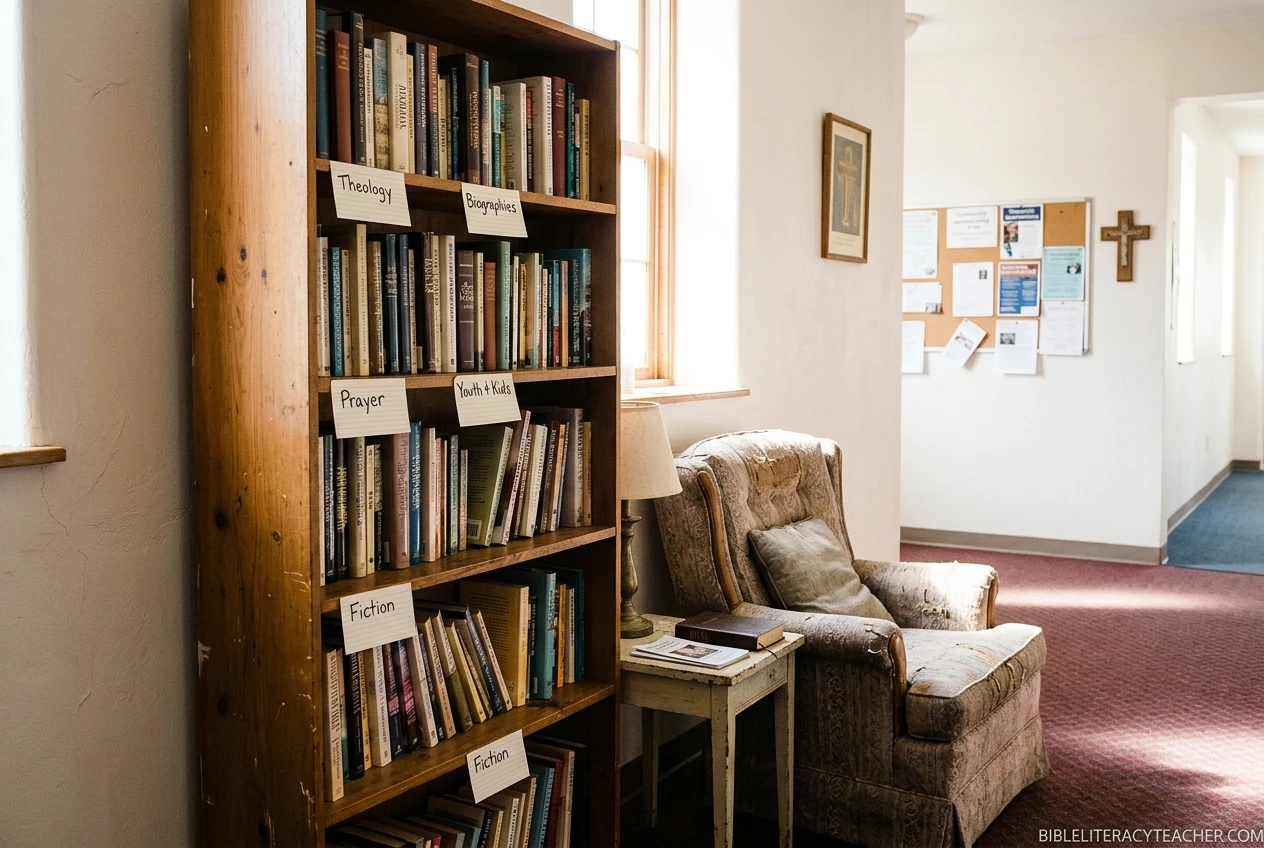
Church lending shelves. Many churches keep a small library or a book table. Books on it have often been chosen or at least noticed by people who know the church’s teaching. Ask a pastor, elder or small group leader what is on the shelf and why. You can also ask what they would read next on the subject you are studying, which is a better question than “what is good?”
Public-domain classics archives. Older Christian writings that are out of copyright are often available free online from archives dedicated to them. Old sermons, devotional writings and theological works have been read by generations of believers, which counts for something. Still, age does not make a book correct on every point, so run the same five questions on it. Also note that copyright depends on the country and the edition. An old text can be free while a modern translation, a new introduction or added notes remain protected, so read each archive’s terms before you copy or share anything.
Marketplaces. Large online marketplaces sell used and new copies at lower prices, which makes them useful once you have decided on a title. They are a poor place to discover one. Their search results and “customers also bought” lists rank by sales and not by soundness, and anyone can sell or self-publish. Find the book first through a source you trust, then use a marketplace to buy it cheaply, and check that the edition is the one you meant.
Spotting red flags: prosperity promises, fabricated quotes and one-verse theology
A few patterns come up repeatedly, and you can learn to see them quickly.
- Prosperity promises. The book treats giving, faith or declarations as a way to get money, health or status. Paul warns about those who suppose “that godliness is a means of gain” (1 Timothy 6:5) and says that “the love of money is a root of all kinds of evils” (1 Timothy 6:10).
- Fabricated or unsourced quotations. Famous names are attached to lines with no title, page or date. If you cannot trace a quote, the author has not shown you it is real.
- One-verse theology. A major teaching rests on a single sentence lifted from its passage. Even the devil quoted Scripture in the wilderness (Matthew 4:6, quoting Psalm 91), and Jesus answered by turning to other Scripture that showed the verse’s true meaning (Matthew 4:7). Sound teaching reads the whole passage and the whole Bible.
- Private revelation presented as authority. The author says God gave them a message that readers must accept, with no way to test it against Scripture. The Bible tells us, “Test everything; hold fast what is good” (1 Thessalonians 5:21), and “test the spirits to see whether they are from God” (1 John 4:1).
- A Jesus without a cross. The book mentions repentance, sin or sacrifice rarely or never.
One red flag does not always mean a book is worthless. A sound author can quote a doubtful line or phrase a promise carelessly. Several flags together, especially a prosperity promise combined with thin use of Scripture, are a sound reason to put the book down.
What to do when trusted Christians disagree about a book
You may find that a pastor you respect loves a book and another mature believer warns against it. This happens, and it does not always mean one of them is wrong.
First, sort the disagreement. Some matters are central to the faith, such as who Jesus is, the authority of Scripture and salvation by grace through faith. Other matters, such as baptism, end-times views or worship style, are ones on which faithful Christians differ. Romans 14 teaches believers to handle disputable matters with patience and not to despise or condemn one another. If the disagreement is over a secondary point, a book can still be useful when you read it knowing where it differs from your church.
If the disagreement is over a central point, do the work the Bereans did. Read the passages in question in your Bible. Ask each person which pages concern them, and read those pages. Then take what you find to your pastor or an elder, since “in an abundance of counselors there is safety” (Proverbs 11:14). Waiting a few weeks before buying costs you nothing.
When you still cannot decide, choose another book on the same subject from a source your church uses. There is rarely only one good book on a topic.
Building a short reading list with the books you already own, and where to go next
Before you buy anything new, take stock of what is on your shelf, e-reader or phone. Many believers own several Christian books they never finished, and some of them will pass the five questions well.

- List every Christian book you own, including gifts and hand-me-downs.
- Run the five questions on each, spending a few minutes on the ones you have never opened.
- Sort them into three groups: read now, read later with care, and give away or set aside.
- Pick one book from the first group and finish it before you add another.
Check the footnotes and recommended reading sections of the good ones. A careful author tells you which books they depend on, and that gives you a trustworthy next title from a source you have already tested. If you want a book that asks you to put what you learn into practice, our guide to the best Christian discipleship workbooks judges each one by whether it changes how you live.
A short list that you read all the way through will do more for your understanding of Scripture than a large library you only browse. Keep the Bible as your main text and let each book help you read it better.
Ready to choose a book for your next season of study? Read how to pick the right Bible commentary for your passage at /how-to-pick-the-right-bible-commentary-for-personal-study/, then compare study Bibles at /five-study-bibles-for-new-believers-compared-side-by-side/.