Redemption in the Bible: One Story from Genesis to Revelation
Many people read the Bible as separate stories: Adam and Eve in one place, Moses in another, David somewhere else, and Jesus at the end. From its first pages to its last, though, the Bible tells one story, in which God rescues and restores what sin has broken. That story is redemption in the Bible, and seeing it changes how you read every book.
It matters personally too. Many believers carry guilt, habits they cannot break or fear about the future. Scripture presents God as a Redeemer who buys people back, sets them free and makes them new. This article follows that story through seven key passages, from the Fall to the new creation.
What Does Redemption Mean in the Bible?
To redeem means to buy back or set free by paying a price. In the ancient world the word described releasing a slave, recovering family land that had been sold, or rescuing a relative from debt. Each case involves someone in bondage, a price and a person who pays it.
The Old Testament has three main words for this:
- Ga’al means to redeem as a family member. The go’el, or kinsman-redeemer, rescued a relative who had lost land or freedom (Leviticus 25:25, 47-49). Boaz did this for Ruth and Naomi (Ruth 4), and Job declared that his Redeemer lives (Job 19:25).
- Padah means to ransom or deliver, and describes God rescuing Israel from Egypt (Deuteronomy 7:8).
- Kopher is a ransom price, the cost paid to release a life (Exodus 30:12).
The New Testament uses lytron, a ransom, when Jesus says He came to give His life as a ransom for many (Mark 10:45). It uses apolytrōsis for the release a ransom secures (Romans 3:24; Ephesians 1:7), and agorazō for buying someone in the marketplace (1 Corinthians 6:20).
Redemption also brings belonging. A kinsman-redeemer acted because the person in trouble was family. In Christ, God redeems us so that we are adopted as His children (Galatians 4:4-5).

Seven Key Scriptures on Redemption
1. Genesis 3: The Fall and the Need for Redemption
Adam and Eve trust the serpent’s promise over God’s command, and sin breaks everything at once. Shame replaces innocence (3:7), hiding replaces fellowship (3:8-10) and blame replaces honesty (3:12-13). Work becomes toil, death enters the human story, and the couple are sent away from the tree of life (3:16-24).
Even in judgment, God promises that the woman’s offspring will crush the serpent’s head (3:15). Many Christians since the early church have called this the protoevangelium, the “first gospel.” Genesis 3 explains why redemption is needed, and the rest of the Bible answers it.
2. Exodus 12: Rescue by the Blood of a Lamb
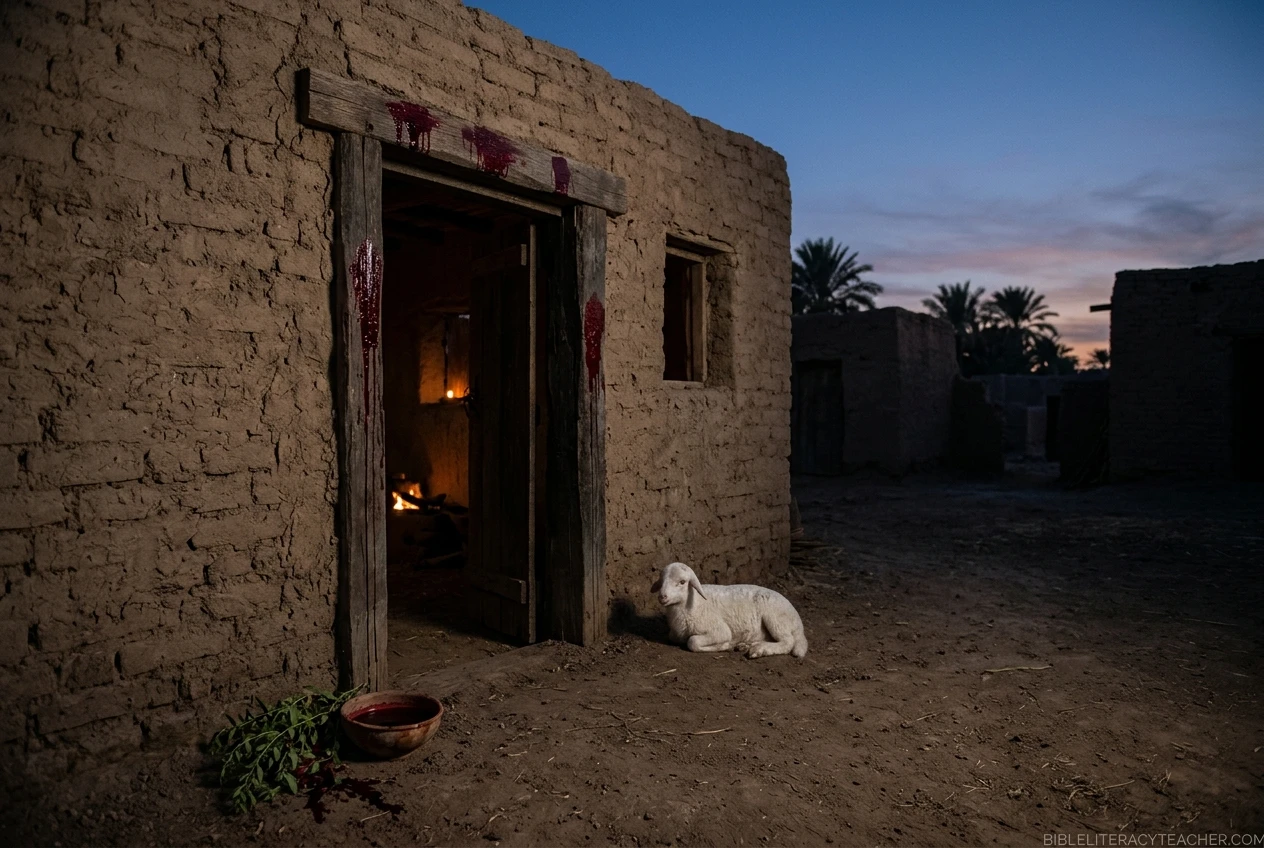
Israel is enslaved in Egypt, and the tenth plague is coming. Each household is to sacrifice a lamb without blemish and put its blood on the doorframes. When God sees the blood, He will pass over that house (12:5-7, 13).
Israel was spared because they sheltered under the blood God provided, not because they were better than the Egyptians. John the Baptist called Jesus the Lamb of God (John 1:29), and Paul calls Christ our Passover lamb (1 Corinthians 5:7).
3. Psalm 51: Redemption Begins with Honest Repentance
The psalm’s heading links it to David’s sin with Bathsheba and the death of Uriah (2 Samuel 11-12). David makes no excuses. He appeals only to God’s steadfast love (51:1) and asks God to create in him a clean heart (51:10).
He also learns that God desires a broken and contrite heart more than ritual (51:16-17). No sacrifice could fix David’s heart, so he asks God to make a new one, which the prophets later promise (Ezekiel 36:26). Redemption is a public event in history, and it is also a personal cleansing.
4. Isaiah 53: The Servant Who Takes Our Place
Isaiah wrote centuries before Jesus about a Servant who is despised and rejected (53:3). The ESV renders verse 5: “he was pierced for our transgressions; he was crushed for our iniquities.” He is led like a lamb to the slaughter (53:7), and through Him many are made righteous (53:11).
This is substitution: the Servant suffers for the sins of others. Many Jewish interpreters understand the Servant as Israel, but the New Testament applies the passage to Jesus (Acts 8:32-35; 1 Peter 2:24-25).
5. Matthew 26 to 28: The Price Is Paid
At the Last Supper, Jesus calls the cup His blood of the covenant, poured out for the forgiveness of sins (26:28). He had already said He came to give His life as a ransom for many (Matthew 20:28). When He dies, the temple curtain tears from top to bottom (27:51), and Hebrews reads this as the way into God’s presence being opened (Hebrews 10:19-20).
On the third day the angel announces, “He has risen, as he said” (28:6). The resurrection is God’s public declaration that the price was accepted (Romans 4:25).
6. Acts 2: A Redeemed People Is Born
At Pentecost the Spirit comes on the disciples, and Peter explains the event from Joel’s prophecy. He calls the crowd to repent and be baptised in the name of Jesus Christ for the forgiveness of sins, and about three thousand believe (2:38, 41).
Redemption also forms a community. The new believers devote themselves to teaching, fellowship, the breaking of bread, prayer and generosity (2:42-47). Christians differ on how baptism relates to forgiveness in verse 38. All agree that forgiveness rests on Christ’s work and is received through repentance and faith.
7. Revelation 21 and 22: All Things Made New
John sees a new heaven and a new earth. God dwells with His people and wipes away every tear (21:1-4). The One on the throne says, “Behold, I am making all things new” (21:5). The tree of life returns, and there is no longer any curse (22:2-3).
Redemption therefore reaches the whole creation, not only individual souls (Romans 8:19-23). Christians read the imagery of Revelation in different ways, but they agree that Christ will return, evil will be judged and God will dwell with His people.
Redemption in Three Tenses
The New Testament speaks of redemption in the past, present and future:

- Past: In Christ we have redemption through His blood, the forgiveness of sins (Ephesians 1:7).
- Present: The Spirit is transforming us now (2 Corinthians 3:18).
- Future: We wait for the redemption of our bodies (Romans 8:23).
New believers especially can take comfort in this. You are fully forgiven today even while you are still growing.
What Redemption Changes Today
Your past does not have the final word. David’s story shows that serious sin is not beyond God’s mercy when we come honestly (1 John 1:9). Your worth also rests on a price, not on likes, grades or income: you were bought with the blood of Christ (1 Corinthians 6:19-20).
Redeemed freedom has a purpose. Christ redeemed us so that we would belong to God and be zealous for good works (Titus 2:14). And because redemption creates a family, faith was never meant to be a solo journey (Hebrews 10:24-25).
Living as a Redeemed Person This Week
- Read the story in seven days. Read one of the seven passages each day, and after each one write a sentence answering, “What does this show me about God as Redeemer?”
- Pray Psalm 51 slowly. Name specific sins to God rather than speaking in general terms, then thank Him for forgiveness through Christ.
- Replace a lie with a verse. Pick one thought you believe about yourself, such as “God could never use me,” and answer it with Ephesians 1:7 or 2 Corinthians 5:17.
- Forgive someone. If someone has wronged you and never apologised, how to forgive someone who never said sorry looks at how Jesus responded on the cross.
- Be ready to share your story. Be prepared to explain your hope when someone asks (1 Peter 3:15).
Questions to Reflect On
- Do you read the Bible as one connected story or as separate stories?
- Where are you tempted to hide from God or blame others, as Adam and Eve did?
- Is there a sin or regret you have never fully brought to God?
- In what area of life do you still live like a slave, though Christ has set you free?
Closing Prayer
Heavenly Father, thank You for being my Redeemer. When I could not save myself, You sent Jesus, the Lamb of God, to give His life as the ransom for my freedom. Like David, I ask You to create in me a clean heart and renew a right spirit within me. Help me to live each day as someone bought with a price, free from sin’s control and free to serve You. Keep my eyes on the day when You will wipe away every tear and make all things new. In the name of Jesus Christ, my Redeemer. Amen.