What does the Bible say about comparison and social media? Scripture never mentions a phone, but it describes the feeling exactly: you look at someone else’s life and your own seems smaller. The Bible does not answer that feeling with a list of rules about apps. It answers with a question about who you are and what God has already put in your hands.
Two passages carry most of the answer: Philippians 4:11-13 and 1 Timothy 6:6-8. Both were written to people who had real reasons to want more, and neither is about screen time.
Why Scrolling Leaves You Feeling Behind When Nothing Has Changed
Your job, your bank balance, your health and your friendships are the same at the end of a scroll as they were at the start. What changed is the standard you are measuring them against.
In a few minutes you can see a engagement, a promotion, a holiday abroad, a new car and a ministry milestone, all from different people. Each of those posts was chosen, edited and timed by the person who shared it. You see your own life from the inside, including the slow weeks, the unanswered prayers and the bills. So the comparison is between someone’s selected best moment and your complete ordinary week, and your week will lose every time.

Churchgoing believers are not exempt. A baptism photo, a mission trip, a worship night with a packed room or a friend who seems to hear from God more clearly can all make you feel spiritually behind. The feeling usually points to a belief underneath it: that your worth or security depends on what other people have or have done. Scripture speaks directly to that belief.
Comparison Is Older Than Instagram
The first recorded case of comparison ends in murder. In Genesis 4, God looks with favour on Abel’s offering and not on Cain’s. Cain is “very angry” and his face falls. God speaks to him before anything happens and says that sin is crouching at the door, and that Cain must rule over it (Genesis 4:5-7). God asks Cain to deal with his own heart and offers him the chance to do right. Cain looks at his brother instead.
King Saul shows the same pattern in 1 Samuel 18. After a military victory the women sing that Saul has struck down his thousands and David his tens of thousands. The text says Saul was very angry and that from that day he “eyed David” (1 Samuel 18:6-9). Saul was still king and still had an army. A song about someone else’s success was enough to make him treat a loyal servant as a threat.
The third example is in Jesus’ story of the two sons in Luke 15. The older brother has stayed home and worked for years. When his father throws a feast for the returning younger son, he refuses to go in and says he was never given even a young goat to celebrate with his friends (Luke 15:29). The father’s reply is gentle: “you are always with me, and all that is mine is yours” (Luke 15:31). The older son had access to everything and was living as if he had nothing.
Each of the three was already provided for, and each looked sideways instead of at what he had been given.
What Paul Meant by “I Have Learned to Be Content”
Paul wrote Philippians while in custody (Philippians 1:12-14). He had every outward reason to feel that life had gone badly. Yet he writes, “I have learned in whatever situation I am to be content” (Philippians 4:11). If you want background on his life, the article on who Paul the apostle was covers it.

The word that matters is learned. Contentment is something Paul acquired, and he says so. He describes knowing what it is to be brought low and what it is to have plenty, and he calls his knowledge “the secret of facing plenty and hunger, abundance and need” (Philippians 4:12). That secret is not a mood. It is a settled reliance on Christ that does not move when circumstances do.
Then comes verse 13: “I can do all things through him who strengthens me.” Read in context, “all things” refers to the situations Paul has just listed, which are hunger and fullness, need and abundance. The verse promises strength to endure and stay faithful in either condition. It does not promise that you will win every competition or get what the people you follow have.
Paul makes the same point to Timothy: “godliness with contentment is great gain,” and if we have food and clothing, “with these we will be content” (1 Timothy 6:6-8). He bases it on a plain fact: we brought nothing into the world and can take nothing out of it. Most of what social media displays is the kind of thing Paul says we cannot keep.
What Contentment Says About Ambition
Contentment is sometimes taken to mean that a Christian should want nothing and try for nothing. Paul’s own life contradicts that. In the same letter he writes that he presses on toward the goal he has not yet reached (Philippians 3:12-14). He also worked with his hands as a tentmaker (Acts 18:3) and told the Thessalonians that anyone unwilling to work should not eat (2 Thessalonians 3:10).
Scripture commends diligence. Colossians 3:23 tells believers to work wholeheartedly “as for the Lord.” Proverbs repeatedly warns against laziness. A student can study hard, a young professional can seek a better position and a couple can save for a home, all within contentment.
The difference is the source of the motivation. Ambition driven by comparison asks, “What will make me look as successful as them?” Ambition shaped by contentment asks, “What has God given me to do, and how do I do it well?” The first has no finishing line, because someone will always have more. The second can be satisfied at the end of each day.
Your Identity Is Given, Not Earned
Much of what we post and follow is a search for status: proof that we are doing well enough to be accepted. Scripture places identity somewhere else. Genesis 1:27 says every person is made in God’s image, before any achievement. Ephesians 2:8-10 says believers are saved by grace through faith, “not a result of works,” and are God’s workmanship, created for good works prepared in advance.
Jesus himself shows the order. At his baptism the Father says, “This is my beloved Son, with whom I am well pleased” (Matthew 3:17). That was spoken before Jesus had performed a miracle or taught publicly. If identity can be given before the work, it does not depend on the work. First John 3:1 says it plainly: “See what kind of love the Father has given to us, that we should be called children of God.”
Paul also asks a blunt question in Galatians 1:10: “Am I now seeking the approval of man, or of God?” A like count, a follower number and a friend’s announcement all measure approval from people. For a believer, the verdict that matters has already been given in Christ, and it does not rise or fall with the feed.
Stewardship of What You Already Have
If your life belongs to God, then what you hold is on loan to be managed, not a score to be compared. In the parable of the talents (Matthew 25:14-30), the master gives his servants different amounts “each according to his ability.” The servant with five and the servant with two both double what they were given, and both hear the same words: “Well done, good and faithful servant” (Matthew 25:21, 23). The reward followed faithfulness, not the size of the amount. The servant who buried his talent was condemned for what he did with it, not for having received less than the others.
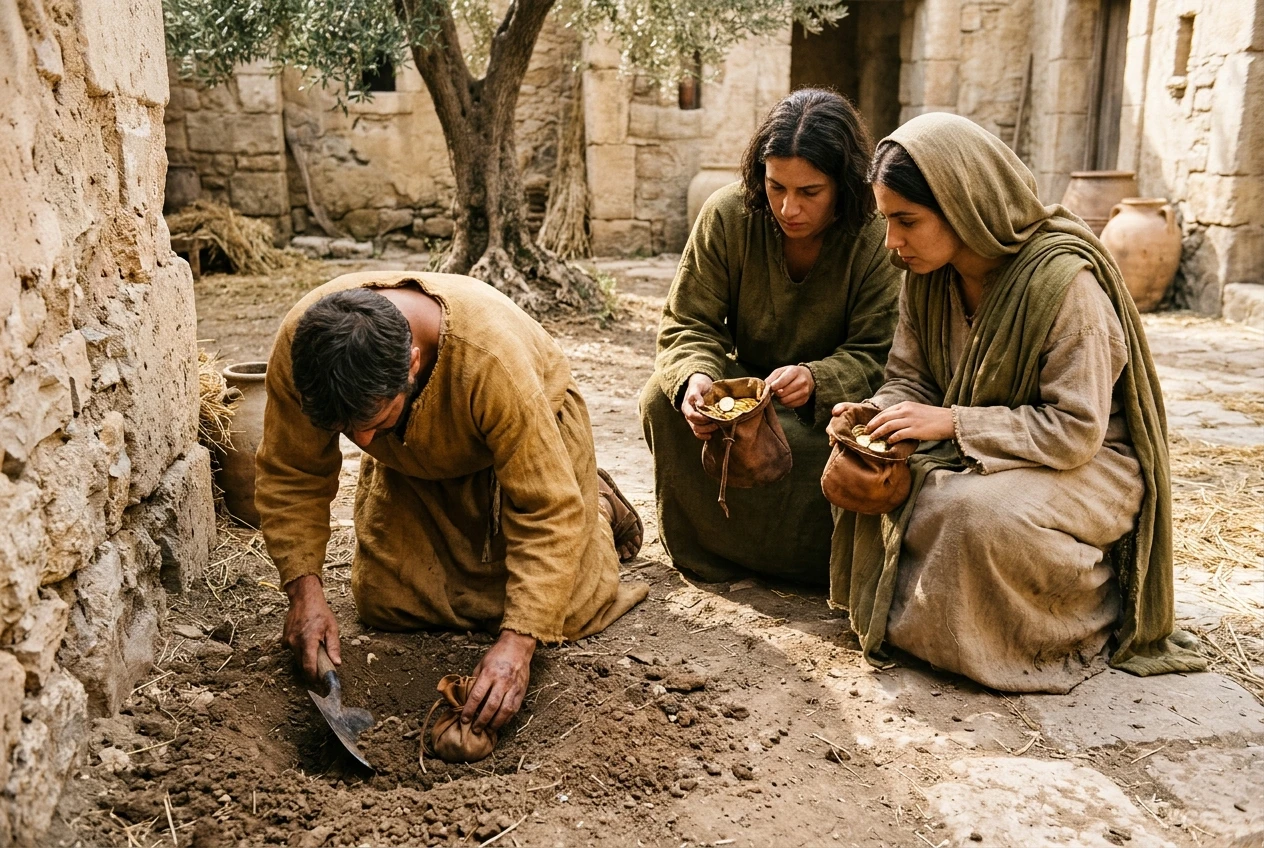
Four things in particular are entrusted to you:
- Time: Hours spent watching other people live are hours not spent on your own responsibilities, relationships and prayer.
- Gifts: Romans 12:6 says we have gifts that differ according to the grace given us. Wishing for someone else’s gift leaves yours unused.
- Money: First Timothy 6:17-19 tells the wealthy to be generous and ready to share, and Hebrews 13:5 says to be content with what you have, because God has promised never to leave or forsake you.
- Attention: What you look at repeatedly shapes what you want. Galatians 6:4 says to test your own work, and then you can take pride in it without comparing yourself to someone else.
When Peter asked Jesus about another disciple’s future, Jesus answered, “What is that to you? You follow me!” (John 21:22). That sentence is a good one to say back to a feed.
A 7-Day Practice for Replacing Comparison With Gratitude and Scripture
This is a one-week experiment. Each day takes about ten minutes. If you want help keeping a reading routine going in a busy week, see how to build a Bible study habit that survives a busy week.

Day 1: Read Philippians 4:10-13 before you open any app. Write down every circumstance Paul mentions and the one thing he says holds steady through them.
Day 2: List what you have been given. Write ten specific things: people, skills, a place to live, a church, a Bible you can read. Be concrete.
Day 3: Name your gifts and one use for them. Read Matthew 25:14-30. Pick one thing you are able to do and do it for someone this week.
Day 4: Guard your attention. Choose the time of day you scroll most and replace its first ten minutes with a Psalm. Notice which accounts leave you feeling smaller, and decide whether to mute them.
Day 5: Read 1 Timothy 6:6-8 and sort your wants. Divide a page into needs and wants. Give something away, however small, to someone with less.
Day 6: Pray for someone you envy. Use their name and ask God to bless them. Romans 12:15 tells us to rejoice with those who rejoice, so send them a sincere word of congratulation.
Day 7: Review and give thanks. Read Psalm 103:2 (“forget not all his benefits”). Look back over the week and write what changed in how you felt, and which verse you will keep.
When Envy Has Already Taken Root
Envy is serious in Scripture. Proverbs 14:30 says it makes the bones rot, and James 3:16 links envy and selfish ambition to disorder and every kind of evil. Naming it as sin is not meant to crush you. It is meant to point you to the remedy.
Psalm 73 shows that a believer can be honest about this. Asaph says he envied the arrogant when he saw their prosperity, and his feet nearly slipped. His view changed when he entered God’s sanctuary and saw things from God’s side. You can begin the same way: tell God plainly what you feel. First John 1:9 promises that if we confess our sins, he is faithful and just to forgive us and cleanse us. Psalm 139:23-24 gives a prayer to use: ask God to search your heart and lead you in the way everlasting.
Then take one small step. Mute one account, thank God for one specific thing, or tell a trusted friend or youth leader what you have been struggling with. Growth in contentment is gradual, as Paul’s word “learned” suggests, and grace covers the days when you slip.
If this article helped, join the Bible Literacy Teacher email newsletter for a weekly Biblical wisdom reflection. Tell us in the comments or on Facebook which verse helped you most when comparison crept in. If you want to go deeper on who you are and what you were made for, read You Born With Purpose: The Purpose of Your Life.