If you are the only Christian in your class, your office or your circle of friends, the question of how to stay faithful to God can feel like it needs an answer in seconds. A joke lands, an invitation comes, someone asks what you think, and everyone is waiting. Most advice tells you to be braver at that moment.
The Bible’s best-known examples of believers under pressure show something different. Daniel, his three friends, Peter and John did not become brave in the moment. They had already settled what they would and would not do, and when the pressure came they acted on it. They also spoke respectfully, and none of them was promised an easy outcome.
Why Being the Only Christian in the Room Feels So Heavy
Part of the weight is social. Humans are built to belong, and a group that laughs at the same things and shares the same assumptions can make a different conviction feel like a defect. You are not weak for feeling this. Scripture treats the pressure as normal. Paul writes, “Do not conform to the pattern of this world, but be transformed by the renewing of your mind” (Romans 12:2). A command to resist a pattern assumes the pattern is pushing on you.
The other part is that you are making the decision alone and in public. There is no time to pray about it, ask a pastor or look up a verse. Whatever you do will be read as a statement about who you are.
That is why the groundwork matters more than the moment. The people in Daniel and Acts were under heavy pressure, and the record shows their decisions were largely made before the pressure peaked.
Daniel Decided Before the Pressure Arrived (Daniel 1:8)
Daniel was a young man taken from Jerusalem to Babylon and enrolled in a three-year training program for the king’s service (Daniel 1:1-5). He was given a new Babylonian name. The program came with a daily allowance of food and wine from the king’s table.
Then comes the verse that matters most: “But Daniel resolved not to defile himself with the royal food and wine, and he asked the chief official for permission not to defile himself this way” (Daniel 1:8).
Notice the order. The verse says he resolved, and then he asked. The decision was made inwardly before anyone challenged him, and the request was shaped by it. He did not wait for the plate to arrive and then improvise.

Notice also what the chapter does not record. It records no objection to learning Babylonian literature and language, which God gave him and his friends skill in (Daniel 1:17). It records no protest over the new name. Daniel served Babylon’s king faithfully for decades. He drew a line at one specific point, and he knew where it was.
Scholars differ on exactly why the royal food was a problem. Some point to meat that was not prepared according to the Law of Moses, some to food offered to Babylonian gods, and some to what it meant to depend on the king’s table. The text does not settle the question. What it makes clear is that Daniel treated the matter as one of obedience to God and not as a matter of personal taste.
Daniel also was not entirely alone. Verses 11 to 17 show three friends keeping the same diet with him. Being the only believer in a room does not always mean being the only one in the building, and it is worth asking whether there is someone who would stand with you if you asked.
Convictions Don’t Require Contempt: How Daniel Asked Respectfully
Look at how Daniel carried the conviction. He did not denounce the king’s menu or lecture the official about Babylonian religion. He asked for permission, and he offered an alternative.
When the chief official, Ashpenaz, said he feared for his own life if the young men looked worse than the others, Daniel went to the steward directly under him and proposed a short trial: ten days of vegetables and water, then compare (Daniel 1:10-14). That proposal respected the official’s real worry and gave him a way to say yes without risk.
Peter gives later believers the same posture in plain words: “Always be prepared to give an answer to everyone who asks you to give the reason for the hope that you have. But do this with gentleness and respect” (1 Peter 3:15). Peter wrote this to Christians who were being slandered for their faith, so the advice is meant for hostile settings and not only friendly ones.
In practice, this separates a conviction from a performance. If you decline something, you can do it without implying that everyone who accepted is a lesser person. A calm “I’ll pass on that one” with a friendly face tells people less about your opinion of them and more about your own commitment, and that is usually all the moment needs.
When Standing Firm Costs Something: Daniel 3 and 6, and What ‘But If Not’ Really Means
Daniel 1 ends well, with the four young men healthier than the rest. If the book stopped there, you could conclude that faithfulness reliably pays off. It does not stop there.
In Daniel 3, Shadrach, Meshach and Abednego refuse to bow to King Nebuchadnezzar’s gold image and are told they will be thrown into a blazing furnace. Their answer is one of the most important sentences in the Bible for anyone under pressure: “If we are thrown into the blazing furnace, the God we serve is able to deliver us from it, and he will deliver us from Your Majesty’s hand. But even if he does not, we want you to know, Your Majesty, that we will not serve your gods or worship the image of gold you have set up” (Daniel 3:17-18).
Look at the phrase “even if he does not.” They believe God can rescue them. They do not claim to know that he will. Their decision does not depend on the outcome. They refuse whether the furnace kills them or not.
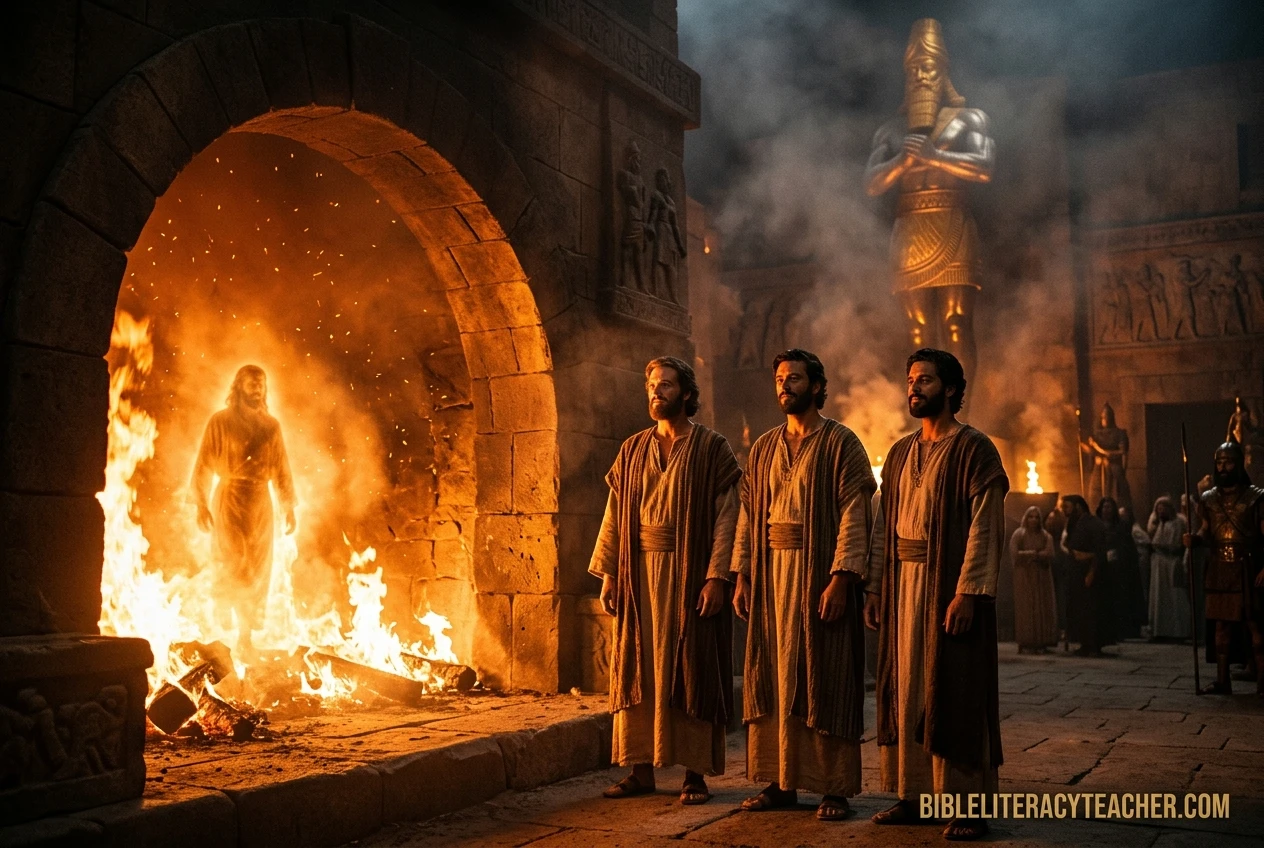
That is the opposite of treating faith as a bargain in which obedience buys safety. In the story, God did deliver them, and a fourth figure appeared with them in the fire (Daniel 3:25). But their statement was made before any of that happened.
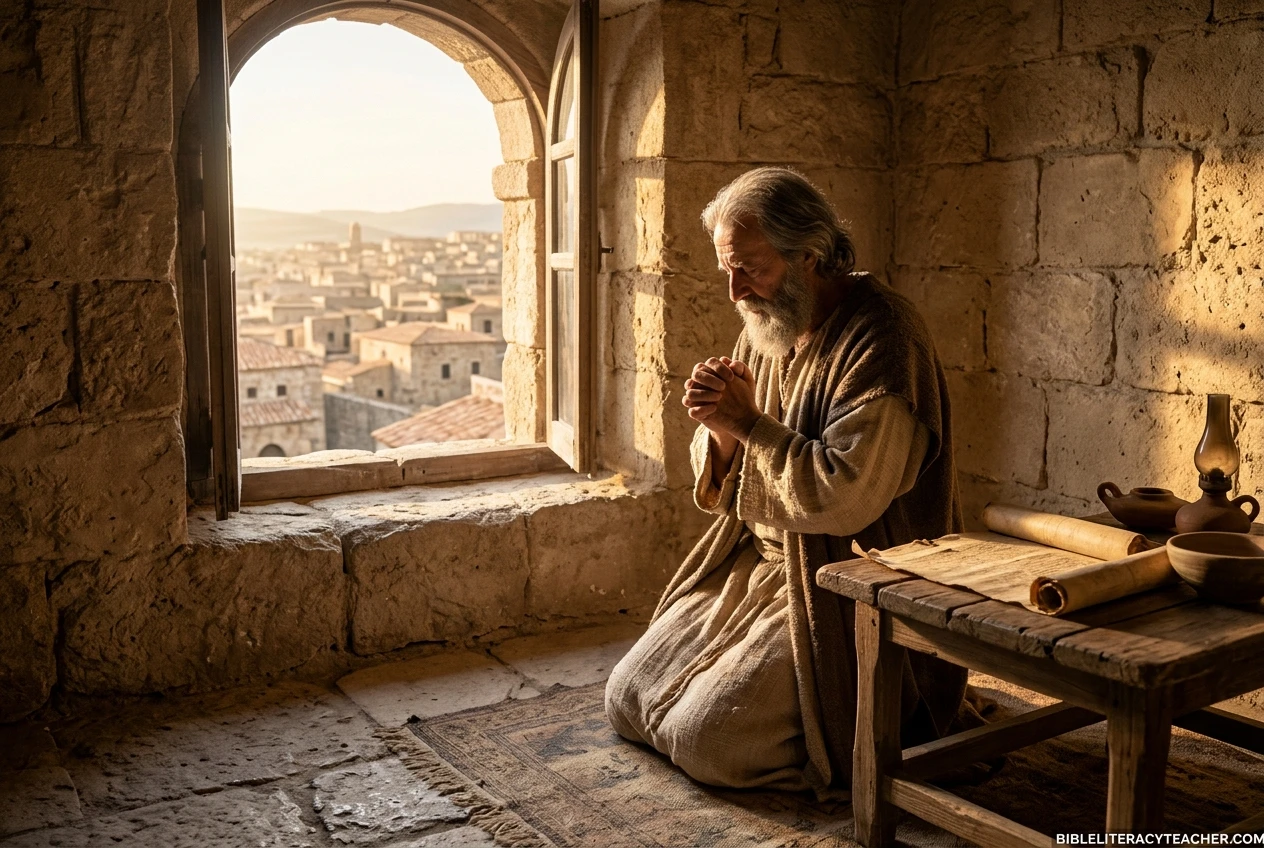
Daniel 6 shows the same thing from another angle. Officials, unable to find any fault in Daniel’s work, arranged a decree banning prayer to anyone but the king for thirty days (Daniel 6:4-9). When Daniel heard of it, “he went home to his upstairs room where the windows opened toward Jerusalem. Three times a day he got down on his knees and prayed, giving thanks to his God, just as he had done before” (Daniel 6:10).
The phrase “just as he had done before” carries the lesson. His prayer habit was already in place, so there was nothing to decide when the law changed. He was thrown to the lions, and God shut their mouths (Daniel 6:22). Many faithful believers in other parts of Scripture and history were not rescued, so the right conclusion is not “God will always spare you.” It is that God is worth obeying whatever follows.
For most readers, the cost will be far smaller than a furnace: being left out, being teased, being passed over, losing a friendship. The principle is the same, and it is worth deciding early whether you can bear that cost.
Peter and John Before the Council: Obeying God Rather Than Men (Acts 4 and 5)
The New Testament repeats the pattern. In Acts 3, Peter and John heal a man who had been lame from birth, and in Acts 4 they are arrested and brought before the same council that had condemned Jesus. They are told to stop speaking in his name.
Their answer: “Judge for yourselves whether it is right in God’s sight to listen to you rather than to God. As for us, we cannot help speaking about what we have seen and heard” (Acts 4:19-20).
Two things stand out. First, the tone. They do not insult the council. They ask a question and let the council weigh it. Second, the observers’ reaction: “When they saw the courage of Peter and John and realized that they were unschooled, ordinary men, they were astonished and they took note that these men had been with Jesus” (Acts 4:13). Their time with Jesus showed. Nothing in the account credits speaking skill, education or status.
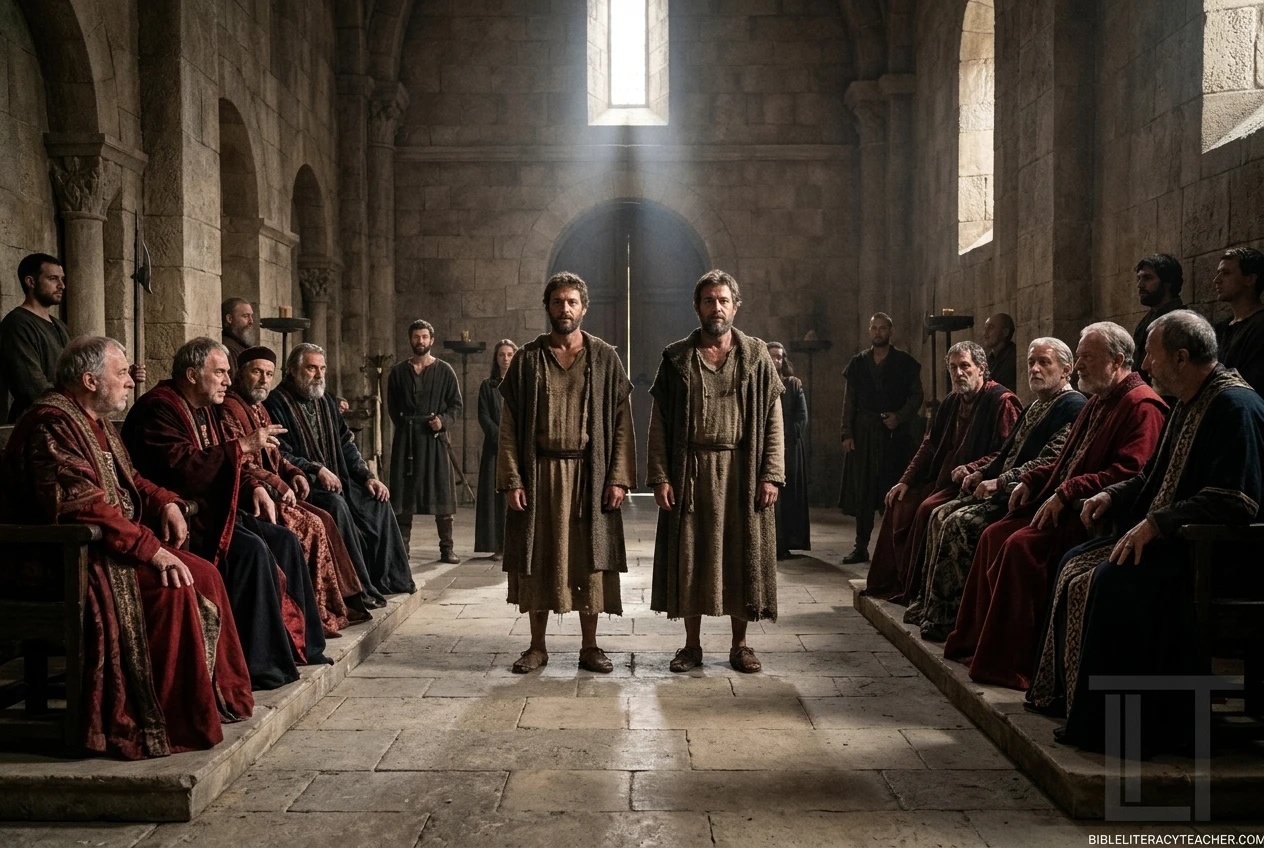
In Acts 5, the apostles are arrested again and the same command is repeated. Peter and the others reply, “We must obey God rather than human beings!” (Acts 5:29). They are flogged and ordered again to be silent. The record then says, “The apostles left the Sanhedrin, rejoicing because they had been counted worthy of suffering disgrace for the name” (Acts 5:41).
Between those two scenes, in Acts 4:29, the believers pray together, and they do not ask for the threats to stop. They ask for boldness to keep speaking. They also went back to their own people after the first release (Acts 4:23). Standing firm was not a solo effort even then.
The Difference Between Pressure to Sin and Pressure to Fit In, and Where Christians Honestly Differ
Not every uncomfortable moment is a furnace. It helps to sort what you face into two categories.
Pressure to disobey God. Being asked to lie for a coworker, join in cruel gossip, cheat on an exam, take part in sexual immorality, deny Jesus or stop speaking of him when asked. Where Scripture speaks clearly, Daniel 3 and Acts 5 apply. You obey God.
Pressure to fit in. Slang, music, dress, the group chat’s humor, what you do on Friday nights, whether you join the office party. Some of this may be harmless, and some may be unwise for you even if it is not sinful. Scripture gives principles here more than commands, such as avoiding crude joking (Ephesians 5:3-4) and not being mastered by anything (1 Corinthians 6:12).
Christians honestly differ about where some activities fall. Sincere believers disagree on alcohol, certain holidays, attending weddings or ceremonies of other faiths, or particular kinds of entertainment. Paul addressed this directly. In Romans 14, he says people should be “fully convinced in their own mind” (Romans 14:5) and should not despise or condemn one another over disputable matters. In 1 Corinthians 8 to 10, he discusses food offered to idols and says the right answer can depend on conscience and on who might be led astray.
So the aim is not to treat every difference as a test of loyalty. Some lines are fixed by Scripture, and others are conscience, wisdom and love. If you are unsure which a particular situation is, the post on making decisions when the Bible doesn’t mention them offers a practical way to work through it.
Three Things to Settle This Week Before the Next Hard Room
Daniel’s example suggests you can prepare ahead of time. Here is how to stay faithful to God when you’re the only Christian, one decision at a time.
1. Name your lines in advance. Write down the two or three things you will not do and ask yourself, for each, whether a specific passage of Scripture stands behind it or whether it is a matter of conscience. Hold the first kind firmly and the second kind humbly. Daniel’s list was short and specific, and that is why he could act on it quickly.
2. Prepare one calm sentence. Peter’s instruction was to be ready to explain your hope with gentleness and respect. Choose a short, friendly way to decline and a short, honest answer to “why?” Say them aloud once. It will sound more natural in the room if it has already been said once outside it.
3. Build the habit that will be there when the pressure comes. Daniel’s prayer life was already running “just as he had done before.” If you have no regular time with God, start small. A short daily reading and prayer is enough, and the guide on building a Bible study habit that survives a busy week can help you keep it going. Also look for one other believer, in your church, family or youth group, who can know what you are facing. The early church prayed together after every threat.
None of this guarantees a comfortable outcome. It does mean that when the moment arrives, you are acting on a decision already made, in the company of a God who, as the three friends said, is able.
Tell us about the room where you feel most alone, whether it is school, work, your friend group or your family, so we can write about that situation next. Share it in the comments or on our Facebook page.